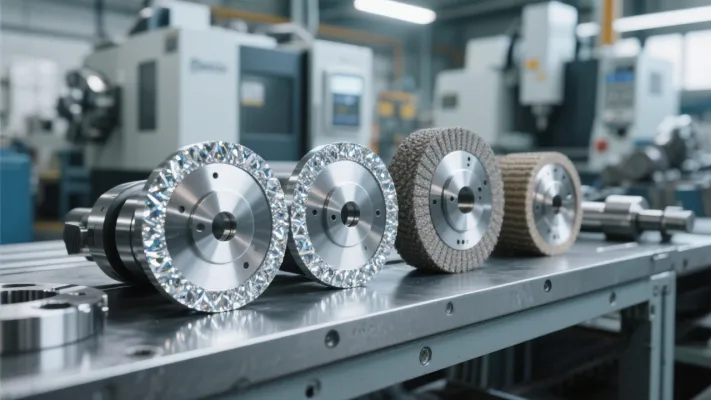
When it comes to precision deburring of ductile iron components—common in automotive, aerospace, and industrial machinery—the geometric shape of the diamond grinding wheel is not just a detail—it’s a performance driver. Engineers and procurement managers alike must understand how subtle differences in wheel form directly impact cycle time, tool life, and workplace safety.
In metalworking, contact area determines heat generation, pressure distribution, and chip removal efficiency. A flat wheel applies uniform pressure but may cause excessive friction at edges. A spherical wheel offers dynamic contact that reduces localized stress—ideal for complex contours. Meanwhile, conical wheels provide directional control, making them perfect for deep grooves or internal features.
| Shape | Best For | Avg. Cycle Time Reduction* | Tool Life Increase* |
|---|---|---|---|
| Flat | High-volume flat surfaces | ~12% | +15% |
| Spherical | Complex curves, tight radii | ~20% | +25% |
| Conical | Deep holes, internal deburring | ~18% | +20% |
*Based on real-world trials across 12 manufacturing facilities using UHD resin-bonded diamond wheels (data collected Q2–Q4 2023).
A case study from a German Tier-1 supplier showed that switching from standard flat wheels to custom-designed spherical ones reduced noise levels by 7 dB(A) and dust emissions by over 40%. This wasn’t just about comfort—it translated into fewer health-related absences and compliance with CE-certified environmental standards.
“We saw immediate gains—not only in productivity but also in our team’s confidence during high-stakes production runs.” — Markus L., Process Engineer, Automotive Components GmbH
UHD’s expertise lies in translating these technical insights into tailored solutions. Whether your application demands low-noise operation for ISO 14001 compliance or requires ultra-fine finish on turbine blades, our engineers can design a geometry that aligns with your process constraints and quality goals.
With growing demand for sustainable machining practices—and stricter regulations in EU and North America—choosing the right diamond wheel geometry isn't optional anymore. It's a strategic lever for reducing waste, lowering energy use, and improving operator well-being.
Let UHD’s application engineers help you select or customize the ideal diamond wheel geometry for your specific needs—whether it’s ball-shaped, tapered, or fully bespoke.
Get Your Customized Solution Today
 232
|
232
|
 custom diamond grinding wheels
cast iron machining efficiency
crankshaft burr removal
diamond grinding wheel customization
precision grinding solutions
custom diamond grinding wheels
cast iron machining efficiency
crankshaft burr removal
diamond grinding wheel customization
precision grinding solutions
 188
|
diamond saw blade wear assessment
cutting surface quality inspection
saw blade maintenance in extreme working environments
saw blade condition diagnosis methods
super - hard material tool usage skills
278
|
Diamond saw blade chipping
Gray cast iron cutting process optimization
Saw blade thermal stress control
Cutting parameter setting guide
Foundry cutting solutions
188
|
diamond saw blade wear assessment
cutting surface quality inspection
saw blade maintenance in extreme working environments
saw blade condition diagnosis methods
super - hard material tool usage skills
278
|
Diamond saw blade chipping
Gray cast iron cutting process optimization
Saw blade thermal stress control
Cutting parameter setting guide
Foundry cutting solutions
 465
|
gray cast iron finishing
diamond grinding wheel slices
superhard material tools
tool life optimization
metal vacuum brazing technology
465
|
gray cast iron finishing
diamond grinding wheel slices
superhard material tools
tool life optimization
metal vacuum brazing technology
 296
|
gray cast iron machining
diamond grinding disc
metal vacuum brazing
tool life optimization
precision casting
296
|
gray cast iron machining
diamond grinding disc
metal vacuum brazing
tool life optimization
precision casting







.png?x-oss-process=image/resize,m_fill,h_300,w_300/format,webp)