UHD Ultrahard Tools
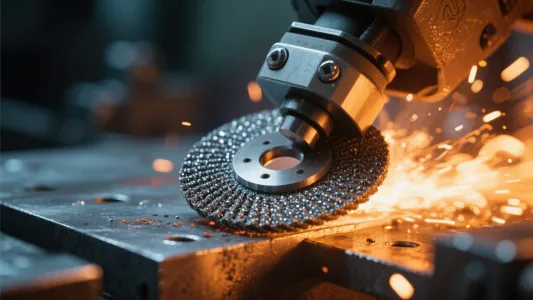
Choosing diamond cutting abrasives is not only a product decision, but also a process decision. The right selection helps industrial buyers match the tool to the material, equipment, precision target, and operating cost requirements of the job. UHD Ultrahard Tools focuses on superhard material tools and provides diamond tool solutions designed for industrial processing needs.
Different workpieces place different demands on diamond cutting abrasives. Metal processing and stone processing, for example, often require different bond structures, cutting behavior, and wear resistance. When the abrasive is matched to the material more precisely, the tool is easier to use in production and more likely to support stable output.
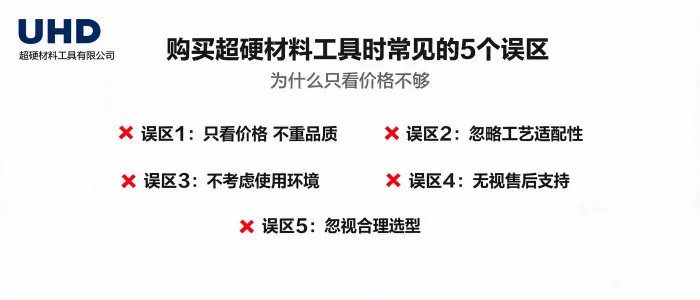
For industrial buyers, the key is to define the actual application first: what is being cut, how the cut is made, and what result is expected. This approach supports better tool compatibility and helps avoid choosing a product only by appearance or price.
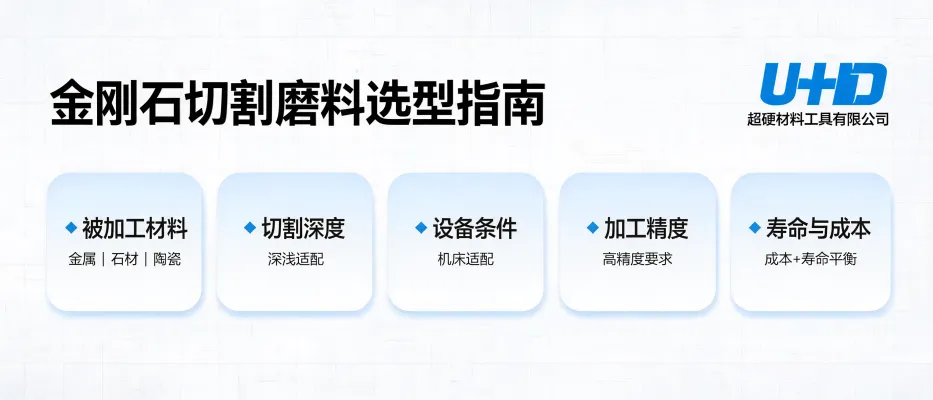
| Selection factor | What to check | Why it matters |
|---|---|---|
| Material type | Hardness, structure, and processing characteristics | Affects cutting behavior and tool suitability |
| Cutting depth | Shallow or deep cutting requirements | Influences tool specification and operation stability |
| Equipment conditions | Machine power, speed, and working environment | Impacts compatibility and processing efficiency |
| Precision requirements | Edge quality, tolerance, and finish expectations | Determines the level of control needed in the abrasive |
| Service life and cost target | Expected usage cycle and procurement budget | Supports a balanced purchasing decision |
Confirm whether the focus is cutting speed, finish quality, stability, or overall operating cost.
Check machine conditions to make sure the abrasive can perform consistently in the actual working environment.
Compare service life, replacement frequency, and process efficiency to support a reasonable procurement choice.
UHD Ultrahard Tools is focused on superhard material tools, including diamond tools, abrasive products, and custom brazed diamond abrasives. This product orientation allows the company to support industrial buyers with solutions that are aligned to specific processing requirements rather than one-size-fits-all recommendations.
The company also emphasizes product positioning and technical service, helping customers evaluate how a tool fits the task before purchase and during application. For B2B buyers, this is especially important when procurement decisions must consider both technical performance and operational efficiency.
A well-chosen diamond cutting abrasive should support the material, the machine, and the process goal at the same time. That is the basis of stable industrial use.
In industrial purchasing, the best results usually come from combining procurement requirements with technical review. Procurement teams often focus on cost, delivery, and supply continuity, while technical teams focus on compatibility, precision, and process behavior. A clear selection framework helps both sides align on the same tool objective.
With this approach, diamond cutting abrasives become part of a broader production solution, helping improve tool compatibility and support more efficient industrial processing.


.png?x-oss-process=image/resize,m_fill,h_300,w_300/format,webp)


 112
|
112
|
 UHD Ultrahard Tools Co., Ltd
ultrahard material tools trend
industrial processing
customized tooling
efficiency improvement
UHD Ultrahard Tools Co., Ltd
ultrahard material tools trend
industrial processing
customized tooling
efficiency improvement
 97
|
UHD Ultrahard Tools Co., Ltd
ultrahard tool procurement
common mistakes
process fit
price judgment
97
|
UHD Ultrahard Tools Co., Ltd
ultrahard tool procurement
common mistakes
process fit
price judgment
 324
|
metal cutting dust control
vacuum brazed diamond blade
industrial dust emission reduction
factory safety standards
green manufacturing
324
|
metal cutting dust control
vacuum brazed diamond blade
industrial dust emission reduction
factory safety standards
green manufacturing
 95
|
vacuum brazed diamond saw blade
hard metal cutting techniques
diamond blade maintenance
high-speed cutting cast iron
automated metal cutting
95
|
vacuum brazed diamond saw blade
hard metal cutting techniques
diamond blade maintenance
high-speed cutting cast iron
automated metal cutting
 314
|
UHD Ultrahard Tools
vacuum brazed diamond grinding disc
metal processing
stone processing
diamond tools
314
|
UHD Ultrahard Tools
vacuum brazed diamond grinding disc
metal processing
stone processing
diamond tools