Selecting a diamond tool is a process decision, not simply a product decision.
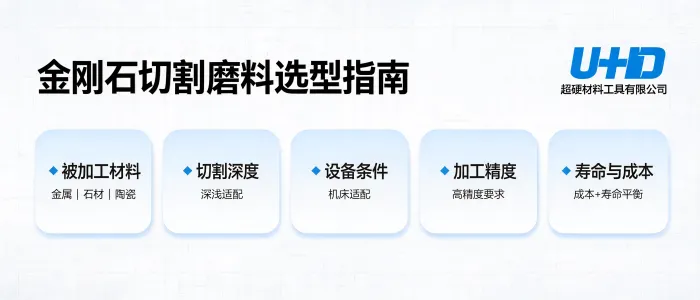
For industrial processing, the right tool should match the processed material, machining method, operating parameters, tool structure, and production objectives. UHD Ultrahard Tools Co., Ltd. helps industrial customers evaluate these factors and identify whether a standard diamond tool or a customized ultrahard material solution is more appropriate.
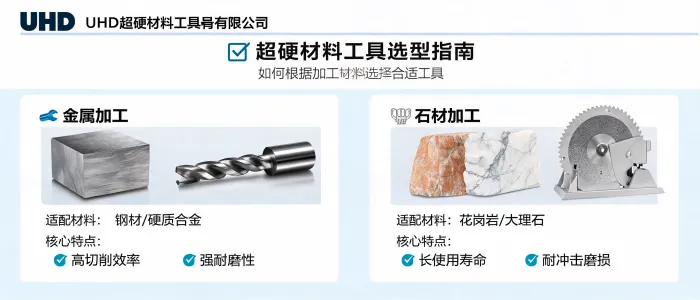
The material being cut, ground, or otherwise processed is the first factor to define. Different materials can vary considerably in hardness, toughness, abrasiveness, thermal behavior, and surface requirements. These characteristics influence the suitable diamond tool structure, diamond concentration, bonding approach, and working configuration.
Hard and wear-resistant materials generally require a tool designed to maintain cutting or grinding capability under demanding contact conditions.
Tough or fracture-sensitive materials may require a different balance between cutting action, support, and process stability.
Material abrasiveness and the required surface finish affect the selection of tool specification and the operating window.
Practical guidance: A tool selected without considering the workpiece material may produce unstable results, unnecessary wear, or an unsuitable surface condition, even when the tool itself is manufactured to a high standard.
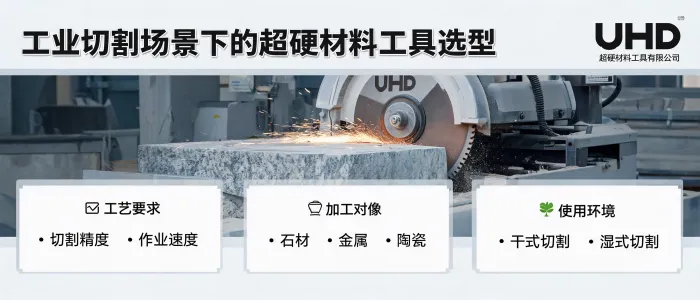
Diamond tools are used in different industrial operations, including cutting, grinding, and other material-removal processes. Each method places different demands on the tool. The selection should therefore reflect how the tool engages with the workpiece rather than relying only on a general product category.
Tool performance is closely connected to operating conditions. Before choosing a diamond tool, industrial buyers should organize the main process parameters and share them with the supplier. This creates a clearer basis for technical evaluation and product matching.
| Parameter area | What to clarify |
|---|---|
| Machine and equipment | Equipment type, available power, mounting conditions, and operating stability. |
| Processing conditions | Cutting or grinding speed, feed conditions, contact behavior, and cooling requirements where applicable. |
| Workpiece requirements | Workpiece dimensions, processing allowance, dimensional expectations, and surface-finish requirements. |
| Production objective | Required throughput, acceptable tool-change frequency, process consistency, and overall cost considerations. |
The tool structure influences how diamond abrasive interacts with the workpiece and how the tool behaves during processing. Selection may involve the tool geometry, working area, abrasive arrangement, bonding method, and connection or mounting requirements.
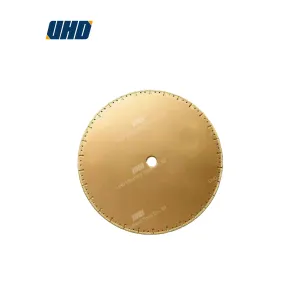
For applications requiring a direct and durable connection between the diamond abrasive and the tool body, vacuum brazed diamond abrasive tools may be considered as part of the technical evaluation. The appropriate configuration still depends on the material, equipment, and process requirements.
Tool life is important, but it should not be evaluated in isolation. A tool with a longer service life may not be the best choice if it reduces process efficiency, affects surface quality, or does not suit the production rhythm. Likewise, a tool optimized for faster processing should be reviewed against wear behavior and consistency.
Standard diamond tools can be suitable when the application, equipment, and operating conditions align with an established specification. A customized ultrahard tool solution may be worth evaluating when standard options do not adequately match the actual process.
The required tool shape, dimensions, or mounting arrangement differs from commonly available specifications.
The workpiece or machining method presents requirements that need a more targeted tool configuration.
The customer needs to evaluate a more specific balance between tool life, process efficiency, and product quality.
A clear technical discussion helps suppliers provide a more relevant recommendation. Industrial customers can prepare the following information:
The most suitable diamond tool is determined by the relationship between material, process, equipment, tool structure, service life, and production objectives. Reviewing these factors together can help industrial buyers make a more informed comparison between standard products and customized solutions.
With a focus on ultrahard materials, diamond tools, abrasive products, and vacuum brazed diamond abrasive solutions, UHD Ultrahard Tools Co., Ltd. provides product development and technical communication for customers seeking application-oriented solutions in metalworking, stone processing, and related industrial fields.
.png?x-oss-process=image/resize,m_fill,h_300,w_300/format,webp)
.png?x-oss-process=image/resize,m_fill,h_300,w_300/format,webp)


 221
|
221
|
 UHD Ultrahard Tools
diamond cutting abrasives selection
industrial cutting tools
tool compatibility
processing efficiency
UHD Ultrahard Tools
diamond cutting abrasives selection
industrial cutting tools
tool compatibility
processing efficiency
 211
|
UHD Ultrahard Tools
ultrahard material tools selection
working condition matching
material hardness
industrial cutting
211
|
UHD Ultrahard Tools
ultrahard material tools selection
working condition matching
material hardness
industrial cutting
 373
|
UHD Ultrahard Tools Co., Ltd
superhard material tool selection
industrial cutting
process requirements
product matching
373
|
UHD Ultrahard Tools Co., Ltd
superhard material tool selection
industrial cutting
process requirements
product matching
 55
|
UHD Ultrahard Tools Co., Ltd
tool selection
metal processing
stone processing
wear resistance
55
|
UHD Ultrahard Tools Co., Ltd
tool selection
metal processing
stone processing
wear resistance
 96
|
UHD Ultrahard Tools Co., Ltd
ultra-hard material tools industry
industrial processing trends
high-performance tools
customized B2B procurement
96
|
UHD Ultrahard Tools Co., Ltd
ultra-hard material tools industry
industrial processing trends
high-performance tools
customized B2B procurement