Industrial Superabrasive Evaluation
Selecting a superabrasive tool is not only a matter of choosing diamond as the abrasive material. Industrial buyers need to consider the workpiece, processing method, required cutting or grinding performance, tool structure, expected service life, and the level of technical support available from the supplier. UHD Ultrahard Tools helps customers evaluate these factors in a structured way when considering diamond cutting tools and vacuum-brazed diamond abrasives.
Different industrial applications place different demands on a tool. A solution suitable for metal processing may not deliver the same result in stone processing, and a tool designed for high cutting efficiency may require a different balance of wear resistance and service life. For this reason, tool selection should begin with the application rather than with a product name alone.
UHD focuses on the development, production, and supply of superhard material tools, including diamond tools, abrasive products, and customized vacuum-brazed diamond abrasives. The company’s approach is to connect tool characteristics with specific process requirements, helping B2B customers make clearer and more technically grounded purchasing decisions.
| Evaluation factor | What industrial buyers should review | Why it matters |
|---|---|---|
| Workpiece material | Material type, hardness, abrasiveness, thickness, and surface characteristics. | Material compatibility influences cutting behavior, abrasive wear, and tool stability. |
| Processing method | Cutting, grinding, edge processing, or another defined operation; wet or dry processing conditions where applicable. | The process determines the required tool structure and operating characteristics. |
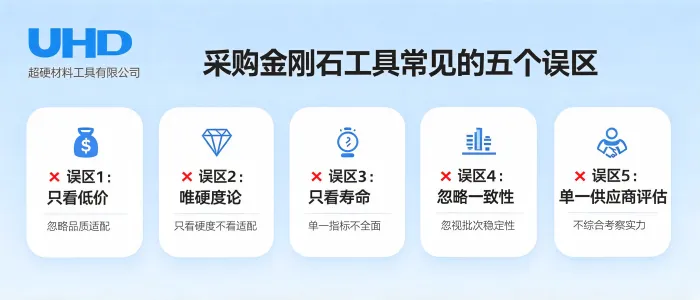
| Performance priorities | Cutting efficiency, edge quality, dimensional consistency, wear resistance, or balanced performance. | A clear priority helps avoid selecting a tool based on a single performance indicator. |
| Tool structure | Abrasive arrangement, bonding or brazing approach, working layer design, and tool geometry. | Structure affects abrasive exposure, heat behavior, cutting action, and service life. |
| Equipment conditions | Machine type, available power, spindle or tool interface, operating speed, and production environment. | The tool must be compatible with the equipment and actual operating conditions. |
| Customization and support | Required dimensions, abrasive specifications, application details, quality expectations, and communication needs. | Technical alignment and supplier support are important when standard tools do not fully match the process. |
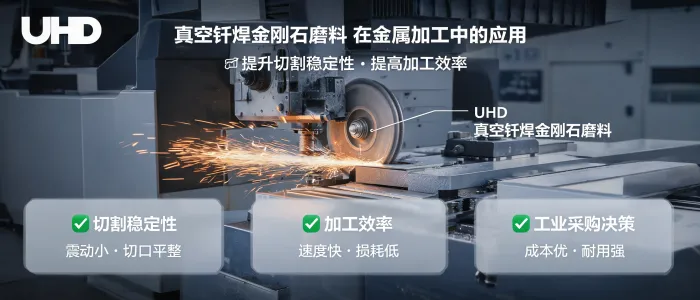
When evaluating diamond cutting tools, buyers should first define the workpiece and the required cutting result. Important considerations include cutting stability, material removal behavior, edge requirements, operating conditions, and the balance between efficiency and wear resistance.
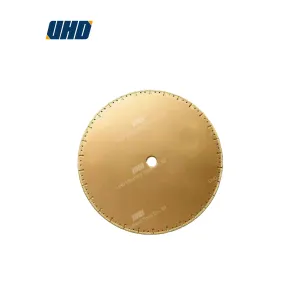
For vacuum-brazed diamond abrasives, the evaluation should include abrasive distribution, working-layer design, tool dimensions, application material, and the intended grinding or cutting conditions. These details help determine whether the abrasive solution is aligned with the process.
Customization may be appropriate when the application involves a specific workpiece material, non-standard dimensions, unusual machine conditions, or a defined balance between cutting efficiency and service life. A useful technical discussion should include the workpiece, process, equipment, desired result, operating environment, and relevant dimensional requirements.
Rather than treating customization as a separate step after product selection, industrial buyers can use these requirements to guide the initial evaluation. This creates a clearer basis for comparing standard and customized superabrasive solutions.
UHD Ultrahard Tools is a China-based high-tech enterprise focused on the research, production, and sales of superhard material tools. Its product scope includes diamond tools, abrasive products, and customized vacuum-brazed diamond abrasives for industrial applications such as metal processing and stone processing.
With an emphasis on quality and innovation, UHD works to position each tool according to its intended process requirements. The company also carries out research and development in cooperation with higher-education institutions, including Henan University of Technology, and maintains a B2B-oriented international trade service system for communication with customers in different markets.
A well-matched superabrasive solution begins with accurate application information. The more clearly the material, process, equipment, and performance priorities are defined, the more effectively buyers and suppliers can evaluate the available options.
For industrial customers comparing diamond cutting tools or vacuum-brazed diamond abrasives, the most reliable starting point is a process-based review. Consider material compatibility, tool structure, cutting or grinding performance, wear resistance, expected service life, technical parameters, customization needs, and supplier support together. UHD Ultrahard Tools can use these requirements as a basis for discussing suitable superhard material tool solutions.


.png?x-oss-process=image/resize,m_fill,h_300,w_300/format,webp)

 260
|
260
|
 UHD Ultrahard Tools Co., Ltd
industrial tool procurement
supplier evaluation
superhard material solutions
B2B purchasing decision
UHD Ultrahard Tools Co., Ltd
industrial tool procurement
supplier evaluation
superhard material solutions
B2B purchasing decision
 57
|
UHD Ultrahard Tools Co., Ltd
vacuum brazed diamond cutting abrasive
ultrahard material tools
industrial cutting
metal processing
stone processing
57
|
UHD Ultrahard Tools Co., Ltd
vacuum brazed diamond cutting abrasive
ultrahard material tools
industrial cutting
metal processing
stone processing
 73
|
UHD
diamond tool procurement
selection mistakes
tool life
supplier evaluation
318
|
UHD
superhard material tool parameters
operating checklist
procurement validation
engineering team
73
|
UHD
diamond tool procurement
selection mistakes
tool life
supplier evaluation
318
|
UHD
superhard material tool parameters
operating checklist
procurement validation
engineering team
 418
|
UHD
vacuum brazed diamond abrasives
metalworking case study
cutting stability
processing efficiency
418
|
UHD
vacuum brazed diamond abrasives
metalworking case study
cutting stability
processing efficiency