
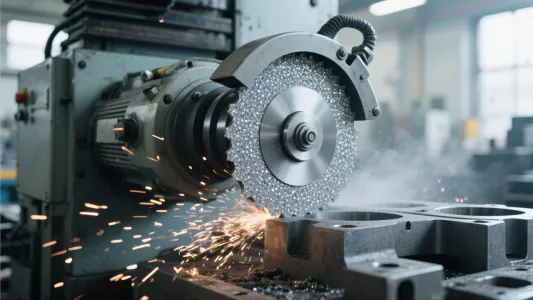
When operating in extreme conditions such as high temperatures, high vibrations, or intermittent cutting, it's a common challenge for on - site operators and technical engineers to determine whether a diamond saw blade is still in its optimal state. Extreme conditions can have a significant impact on diamond saw blades, leading to various common malfunctions.
Under high - temperature environments, the bonding agent of the diamond saw blade may soften, causing the diamond particles to loosen and fall off. High - vibration conditions can lead to uneven stress distribution on the saw blade, accelerating wear and tear. Intermittent cutting causes sudden changes in force and temperature, which can also damage the saw blade structure. Common fault manifestations include reduced cutting efficiency, increased noise during cutting, and poor cutting surface quality.
Using a portable microscope, you can observe the distribution of diamond particles on the saw blade. In a new and well - functioning saw blade, the particles are evenly distributed. As the saw blade wears, the particles may become unevenly distributed, fall off, or be worn down. For example, if you notice that the number of particles in a certain area has decreased by more than 30% compared to a new saw blade, it may be a sign of significant wear.
Listen carefully to the sound during the cutting process. A properly functioning saw blade produces a relatively smooth and consistent cutting sound. When the saw blade is worn, the sound may become louder, more irregular, or have a screeching noise. For instance, if the decibel level of the cutting sound increases by more than 10 decibels compared to normal operation, it indicates a potential problem with the saw blade.
An infrared thermometer can be used to monitor the temperature rise of the saw blade during cutting. In normal operation, the temperature rise of the saw blade should be within a certain range. If the temperature rises by more than 20°C compared to the normal operating temperature, it may suggest excessive friction due to wear.
Analyze the cutting surface quality, including the smoothness of the cutting surface, the size of burrs, and the cutting volume per unit time. A well - functioning saw blade produces a smooth cutting surface with small burrs and a relatively stable cutting volume. If the cutting surface becomes rough, the burrs become larger, and the cutting volume per unit time decreases by more than 20%, it indicates that the saw blade is wearing out.
Let's take a real - world case as an example. In a high - temperature and high - vibration cutting operation, a technical engineer used the above four methods to detect a diamond saw blade. Through microscope observation, it was found that the particle distribution in some areas was uneven, with a particle loss rate of about 25%. The cutting sound was louder than normal, with an increase of about 12 decibels. The temperature rise monitored by the infrared thermometer was about 25°C higher than normal. The cutting surface had more burrs, and the cutting volume per unit time decreased by about 25%. Based on these results, it was determined that the saw blade was in a state of significant wear. The decision was made to continue using the saw blade for a short period but closely monitor its performance to avoid sudden failure.
Scientific evaluation of diamond saw blade wear has many benefits. It can improve cutting efficiency. By accurately identifying the wear state of the saw blade, you can avoid using a worn - out saw blade, which may lead to a 30% - 50% reduction in cutting efficiency. It also reduces losses. Blindly replacing saw blades can cause unnecessary cost waste. Scientific evaluation can help you replace saw blades at the right time, saving up to 20% - 30% of the cost. In addition, it can extend the service life of the saw blade, allowing you to get more value from each saw blade.
If you want to learn more about high - quality solutions for UHD super - hard material tools, click here to explore our products that use advanced vacuum sintering technology to ensure stable particle arrangement and long - term reliable performance.
Do you have any experience in detecting diamond saw blade wear? Share your stories in the comments below!

 451
|
451
|
 Diamond saw blade detection
High - temperature saw blade state monitoring
Cutting tool performance evaluation
Portable microscope application
Infrared temperature measurement for cutting tools
446
|
diamond saw blade chipping
gray cast iron cutting
thermal stress control
cutting parameter optimization
foundry machining
Diamond saw blade detection
High - temperature saw blade state monitoring
Cutting tool performance evaluation
Portable microscope application
Infrared temperature measurement for cutting tools
446
|
diamond saw blade chipping
gray cast iron cutting
thermal stress control
cutting parameter optimization
foundry machining
 40
|
vacuum brazed diamond blades
eco-friendly cutting discs
metal cutting blade selection
diamond blade durability
industrial dust control solutions
99
|
diamond saw blade chipping
gray cast iron cutting optimization
saw blade thermal stress
cutting parameter adjustment
diamond grain size selection
40
|
vacuum brazed diamond blades
eco-friendly cutting discs
metal cutting blade selection
diamond blade durability
industrial dust control solutions
99
|
diamond saw blade chipping
gray cast iron cutting optimization
saw blade thermal stress
cutting parameter adjustment
diamond grain size selection
 392
|
customized diamond grinding wheels for cast iron
diamond wheel selection guide
gray cast iron deburring solutions
precision machining tool design
high-speed cast iron grinding discs customization
392
|
customized diamond grinding wheels for cast iron
diamond wheel selection guide
gray cast iron deburring solutions
precision machining tool design
high-speed cast iron grinding discs customization






.png?x-oss-process=image/resize,m_fill,h_300,w_300/format,webp)

.png?x-oss-process=image/resize,m_fill,h_300,w_300/format,webp)


