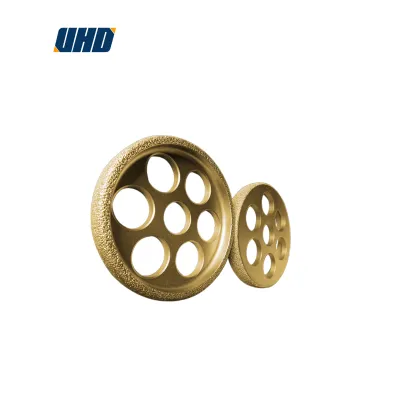
Selecting a vacuum brazed diamond grinding wheel for cast iron automatic grinding requires more than choosing a wheel diameter or diamond specification.
The wheel must correspond to the workpiece structure, grinding area, material removal requirement, target accuracy, surface finish, equipment speed, mounting interface and continuous-operation conditions. UHD Ultrahard Tools Co., Ltd supports this selection process with specification matching, customized grinding cross-section geometry, trial validation and application engineering evaluation based on actual equipment and workpiece conditions.
Vacuum brazing fixes diamond particles firmly to the working surface of the wheel. This construction is designed to support wear resistance, service life and stable abrasive exposure during grinding. For metalworking applications, vacuum brazed diamond grinding wheels can also serve as an alternative to traditional electroplated diamond wheels when the equipment, workpiece and process requirements are properly matched.
Automatic grinding equipment requires consistent interaction between the wheel, machine movement and workpiece geometry. Before final selection, review the following information with the application engineering team:
| Selection information | Purpose in the evaluation |
|---|---|
| Workpiece geometry | Helps determine the required contact area and grinding section shape. |
| Grinding path and axes | Supports compatibility assessment for complex multi-axis automatic movement. |
| Required removal and finish | Provides a basis for selecting the wheel configuration and validating grinding results. |
| Machine speed and mounting | Helps confirm that the wheel can be integrated with the equipment setup. |
| Operating cycle | Supports assessment of durability, process stability and continuous production needs. |
UHD’s vacuum brazed diamond grinding wheel range for automatic grinding includes the UDW455, UDW405, UDW355, UDW305 and UDW255 series. These options are designed for different equipment and application requirements, with selection based on actual working conditions rather than size alone.
When a standard wheel does not fully match the workpiece or grinding path, UHD can provide customized pipe segment geometries and specialized grinding cross-section designs. Customization should be evaluated together with the workpiece profile, contact conditions, machine movement and target grinding result.
UHD Ultrahard Tools Co., Ltd combines vacuum brazing technology, quality control and application-oriented technical support to assist industrial customers with grinding tool selection. The company provides product specifications, technical literature and professional advice from its application engineering team.
This support is particularly relevant when a customer is replacing a traditional electroplated grinding wheel, integrating a wheel with multi-axis automatic equipment or assessing a customized grinding geometry. Final selection should be based on the actual workpiece, machine configuration and process objectives.

 429
|
429
|
 UHD Ultrahard Tools vacuum-brazed diamond cutting abrasive superhard material tools metalworking stone processing
 107
|
UHD Ultrahard Tools resin-bond diamond grinding wheels cast iron deburring tools diamond grinding wheel selection industrial grinding efficiency
107
|
UHD Ultrahard Tools resin-bond diamond grinding wheels cast iron deburring tools diamond grinding wheel selection industrial grinding efficiency
 41
|
UHD Ultrahard Tools Co., Ltd. ultrahard material tools vacuum brazed diamond abrasives metalworking tools stone processing tools
294
|
UHD Ultrahard Tools cast iron slag removal grinding resin-bond diamond grinding wheel industrial abrasive tool selection ductile iron deburring
41
|
UHD Ultrahard Tools Co., Ltd. ultrahard material tools vacuum brazed diamond abrasives metalworking tools stone processing tools
294
|
UHD Ultrahard Tools cast iron slag removal grinding resin-bond diamond grinding wheel industrial abrasive tool selection ductile iron deburring
 150
|
UHD Ultrahard Tools Co., Ltd superabrasive tools vacuum-brazed diamond tools diamond cutting abrasives industrial metal and stone processing
150
|
UHD Ultrahard Tools Co., Ltd superabrasive tools vacuum-brazed diamond tools diamond cutting abrasives industrial metal and stone processing





.png?x-oss-process=image/resize,m_fill,h_300,w_300/format,webp)

.png?x-oss-process=image/resize,m_fill,h_300,w_300/format,webp)