Selecting a vacuum-brazed diamond cutting abrasive is a process decision, not simply a product comparison.
The suitable tool depends on the relationship between the workpiece material, cutting or grinding objective, operating conditions, tool specifications, expected service life, and required production efficiency. UHD Ultrahard Tools Co., Ltd. provides a practical framework to help industrial buyers and technical professionals evaluate these factors before choosing a vacuum-brazed diamond abrasive.
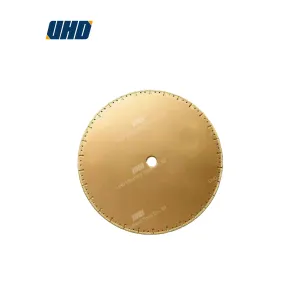
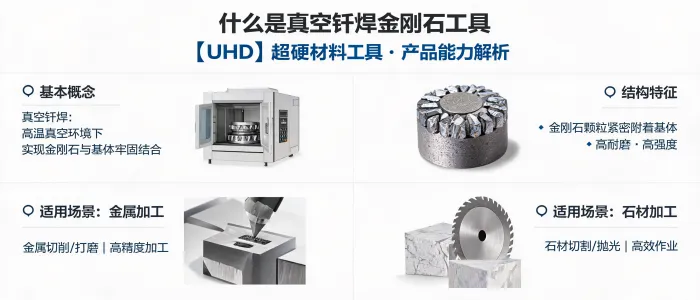
Vacuum-brazed diamond abrasives are superhard-material tools in which diamond abrasive particles are firmly joined to the working surface through a vacuum brazing process. This tool structure is used for cutting, grinding, profiling, and other demanding material-removal applications where high abrasive hardness and a targeted working edge are required.
Because the tool configuration can be adapted to different applications, selection should begin with the actual processing requirement rather than with a single specification such as abrasive size or tool diameter.
Identify the material being cut or ground, its hardness, structure, abrasiveness, and thermal sensitivity.
Clarify whether the priority is cutting, grinding, profiling, edge preparation, surface finishing, or another operation.
Review machine capability, operating speed, feed conditions, cooling method, and workpiece stability.
Match the abrasive tool geometry, dimensions, diamond distribution, and mounting requirements to the application.
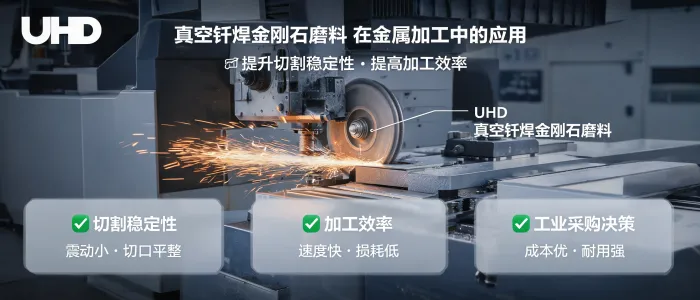
Consider the balance between tool durability, material-removal performance, consistency, replacement frequency, and total operating cost.
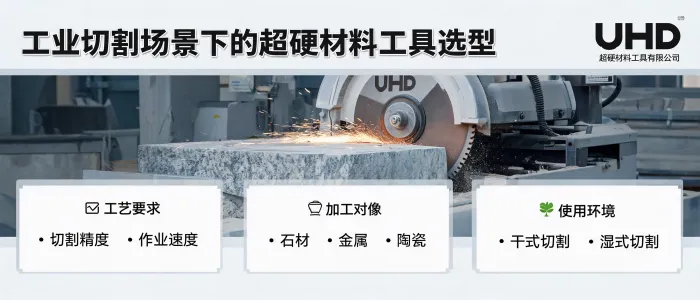
The workpiece is the starting point for abrasive selection. Different materials impose different demands on the tool, including abrasive resistance, cutting stability, heat management, and edge control.
A tool designed for one operation may not be the best choice for another. Before requesting a quotation or technical recommendation, define the intended result as clearly as possible.
| Application question | Why it matters |
|---|---|
| Is the operation cutting or grinding? | The operation determines the preferred tool form, contact condition, and performance priorities. |
| Is dimensional accuracy important? | Precision requirements affect tool geometry, stability, and the way the tool should be applied. |
| Is surface quality a key objective? | Surface-finish expectations should be considered together with abrasive selection and processing parameters. |
| Is production efficiency the main priority? | High-throughput applications require a balanced evaluation of removal rate, consistency, tool life, and changeover needs. |
Even a well-matched abrasive tool may perform poorly when the operating conditions are unsuitable. Selection should therefore include the machine and process environment.
Important: Operating parameters should be established according to the specific machine, workpiece, tool configuration, and application conditions. They should not be copied from an unrelated process without technical verification.
Once the application is defined, the tool specifications can be evaluated more accurately. Relevant information may include:
The lowest initial purchase price does not always represent the most suitable industrial choice. A more complete evaluation considers how the tool performs throughout its use.
Review wear behavior, performance consistency, replacement intervals, and whether the tool remains suitable across the planned production cycle.
Consider material-removal performance, processing stability, product quality, operator requirements, and the time needed for tool changes.
Evaluate the complete application cost rather than focusing only on the unit price of the abrasive tool.
A customized vacuum-brazed diamond abrasive may be appropriate when the application includes unusual workpiece dimensions, a specialized machine interface, complex tool geometry, demanding access conditions, or a specific balance between cutting performance and service life.
For a meaningful technical assessment, industrial buyers should prepare details such as the workpiece material, operation type, machine information, tool dimensions, operating parameters, cooling conditions, quality requirements, and current process challenges. This information allows UHD to evaluate the application more precisely and determine whether a standard or customized solution is more appropriate.
UHD Ultrahard Tools Co., Ltd. focuses on the research, production, and supply of superhard-material tools, including diamond tools, abrasive products, and customized vacuum-brazed diamond abrasives. With a quality-oriented approach and technical cooperation with higher-education institutions, UHD works with industrial customers to connect tool selection with real processing requirements. The right choice begins with complete application information and a clear understanding of the performance expected from the tool.
.png?x-oss-process=image/resize,m_fill,h_300,w_300/format,webp)
.png?x-oss-process=image/resize,m_fill,h_300,w_300/format,webp)


 67
|
67
|
 UHD Ultrahard Tools Co., Ltd
industrial diamond tool procurement
supplier evaluation
quality control
customization capability
UHD Ultrahard Tools Co., Ltd
industrial diamond tool procurement
supplier evaluation
quality control
customization capability
 85
|
vacuum brazed diamond tools
ultrahard tools
metal processing
stone processing
UHD Ultrahard Tools
85
|
vacuum brazed diamond tools
ultrahard tools
metal processing
stone processing
UHD Ultrahard Tools
 372
|
UHD Ultrahard Tools Co., Ltd
superhard material tool selection
industrial cutting
process requirements
product matching
372
|
UHD Ultrahard Tools Co., Ltd
superhard material tool selection
industrial cutting
process requirements
product matching
 113
|
UHD Ultrahard Tools Co., Ltd
ultrahard material tools trend
industrial processing
customized tooling
efficiency improvement
113
|
UHD Ultrahard Tools Co., Ltd
ultrahard material tools trend
industrial processing
customized tooling
efficiency improvement
 417
|
UHD
vacuum brazed diamond abrasives
metalworking case study
cutting stability
processing efficiency
417
|
UHD
vacuum brazed diamond abrasives
metalworking case study
cutting stability
processing efficiency