

Selecting the right vacuum-brazed diamond cutting abrasive requires more than comparing product names. The suitable tool should be matched to the workpiece material, cutting or grinding process, required precision, expected service life, and equipment conditions. UHD Ultrahard Tools supports industrial buyers with practical guidance for evaluating superabrasive tools used in metal and stone processing.
Vacuum-brazed diamond tools are selected according to the relationship between the abrasive structure and the application. Before confirming a tool, buyers should define the material to be processed, the type of operation, the required dimensional control, and the working conditions of the machine.
Identify whether the tool will be used for cast iron, ductile iron, metal components, stone, or another hard material. Material characteristics directly influence the required abrasive configuration and working approach.
Clarify whether the tool is intended for cutting, surface grinding, burr removal, or another operation. The process determines the required tool geometry and operating conditions.
Applications requiring dimensional consistency should prioritize a tool that supports stable material removal and helps maintain the intended size during processing.
Review the machine type, available power, operating speed, tool dimensions, and application method before selecting a high-speed or heavy-duty abrasive tool.
A practical selection process begins with the actual production task rather than with a single specification. The following framework can help industrial purchasers and technical teams organize their requirements.
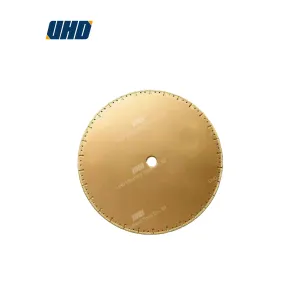
UHD’s manual diamond grinding wheel is designed for high-power, high-speed grinding machines and applications involving slag removal and burr removal from cast iron and ductile iron. It can be considered when an industrial process requires efficient grinding, dimensional control, and a tool suitable for demanding metal-processing conditions.
| Selection consideration | Relevant application reference |
|---|---|
| Material | Cast iron and ductile iron processing |
| Process | Grinding, slag removal, and burr removal |
| Equipment | High-power, high-speed grinding machines |
| Performance priorities | Grinding efficiency, wear resistance, dimensional retention, and reduced dust and odor emissions |
This example illustrates why the same diamond abrasive should not be selected solely by size or appearance. The material, machine, process, and expected result must be evaluated together.
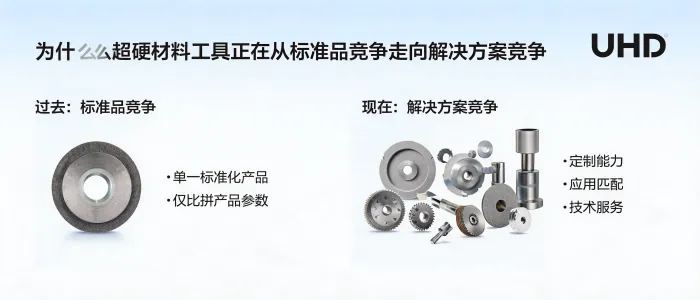
In suitable applications, vacuum-brazed diamond tools may be evaluated as an alternative to conventional resin-bonded or vitrified-bond diamond wheels. The decision should be based on the actual workpiece, process conditions, required precision, and equipment configuration rather than on bonding type alone.
UHD’s product information identifies the manual diamond grinding wheel as an alternative option to traditional resin-bonded and vitrified-bond diamond grinding wheels for relevant industrial grinding tasks. Application-specific evaluation remains important when comparing tool concepts.
Different tools and components may require different geometries, dimensions, and abrasive configurations. UHD provides customized pipe-segment cutting geometries for specific tool concepts and applications, together with technical documentation and guidance from its application engineering team.
Recommended approach: Share the workpiece material, processing method, machine conditions, target precision, and expected service life with the supplier. This information provides a clearer basis for comparing vacuum-brazed diamond cutting abrasives and other superabrasive tool options.
UHD Ultrahard Tools develops and supplies superabrasive tools, diamond tools, abrasives, and customized vacuum-brazed diamond solutions for industrial markets. With a focus on quality, product positioning, and application-oriented technical service, UHD helps buyers assess suitable options for metal and stone processing requirements. For a more accurate recommendation, provide the complete application conditions before selecting the final abrasive specification.
.png?x-oss-process=image/resize,m_fill,h_300,w_300/format,webp)



 367
|
367
|
 UHD Ultrahard Tools Co., Ltd superabrasive tools diamond tools vacuum-brazed diamond abrasives industrial processing
 290
|
UHD Ultrahard Tools vacuum-brazed diamond abrasive diamond cutting tools superabrasive tools metal and stone processing
290
|
UHD Ultrahard Tools vacuum-brazed diamond abrasive diamond cutting tools superabrasive tools metal and stone processing
 314
|
UHD Ultrahard Tools Co., Ltd superhard material tools diamond tools vacuum-brazed diamond tools industrial tool selection
314
|
UHD Ultrahard Tools Co., Ltd superhard material tools diamond tools vacuum-brazed diamond tools industrial tool selection
 429
|
UHD Ultrahard Tools vacuum-brazed diamond cutting abrasive superhard material tools metalworking stone processing
429
|
UHD Ultrahard Tools vacuum-brazed diamond cutting abrasive superhard material tools metalworking stone processing
 224
|
UHD Ultrahard Tools ultrahard material tools diamond tools vacuum-brazed diamond abrasives metal and stone processing
224
|
UHD Ultrahard Tools ultrahard material tools diamond tools vacuum-brazed diamond abrasives metal and stone processing







.png?x-oss-process=image/resize,m_fill,h_400,w_400/format,webp)

