Industrial Superabrasive Tool Guide
Vacuum brazed diamond cutting abrasives are superabrasive tools that use a metallurgical bond to secure diamond particles to a tool substrate. This structure supports stable cutting, durable abrasive retention, and efficient material removal in demanding industrial applications.
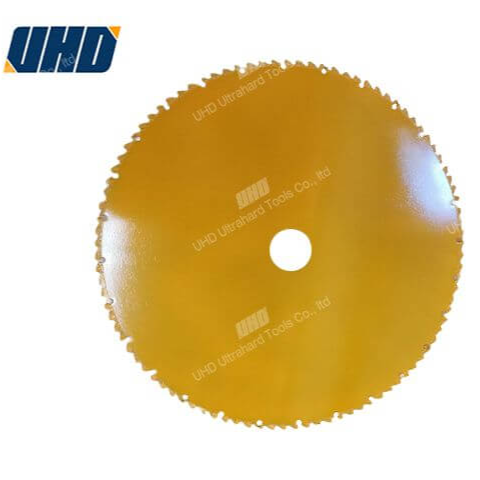
Unlike conventional abrasive tools that depend primarily on a matrix or electroplated layer to hold the abrasive, a vacuum brazed diamond tool is produced by brazing diamond particles to the working surface of a metal substrate in a controlled vacuum process. The resulting diamond-to-substrate bond is designed to provide firm particle retention during cutting.
For industrial cutting and grinding, the tool’s performance depends on more than the abrasive material alone. Substrate design, diamond distribution, cutting-head geometry, operating speed, workpiece material, and equipment conditions must be considered together. This is why vacuum brazed diamond cutting abrasives are often developed around a specific process or machine.
Diamond particles form the active cutting surface and are selected and positioned according to the intended material and cutting requirements.
The brazed connection is designed to hold diamond particles firmly on the substrate, supporting consistent abrasive exposure during use.
The substrate provides structural support. Dynamic balancing helps the tool operate more steadily and contributes to cutting stability and safety.
UHD Ultrahard Tools develops vacuum brazed diamond cutting solutions for demanding industrial processes, including automated cutting and metal processing. The product design focuses on the relationship between cutting efficiency, tool durability, machine compatibility, and operational stability.
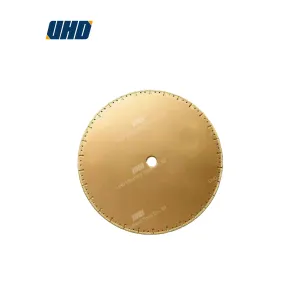
Vacuum brazed diamond cutting abrasives can be evaluated for industrial cutting and grinding applications where durable abrasive retention and controlled cutting behavior are important. UHD’s automatic cutting diamond saw blade is specifically intended for applications involving cast steel or cast iron, including automated metal-cutting processes.
| Application consideration | How it relates to tool selection |
|---|---|
| Automated cutting | The saw blade should be matched to the automated equipment, operating speed, workpiece dimensions, and process requirements. |
| Cast iron and cast steel | Material characteristics influence cutting-head geometry, tool dimensions, speed range, and overall configuration. |
| Industrial metal processing | A suitable vacuum brazed diamond tool can support efficient cutting while helping reduce interruptions caused by frequent tool changes. |
| Stone and other hard-material processing | Tool geometry and specifications should be selected according to the material, equipment, cutting method, and required finish. |
UHD’s vacuum brazed diamond saw blade for automatic cutting is developed for precision-oriented and durable cutting performance. It is designed for demanding automated equipment and is suitable for cast steel and cast iron cutting applications. The tool combines vacuum brazed diamond technology with application-oriented cutting-head geometry.
Available examples include UDS 600M16 and UDS 400amp 80. The appropriate specification and operating range should be confirmed according to the target material, machine configuration, cutting speed, and application conditions.
The most suitable diamond cutting abrasive is determined by the complete application—not by the abrasive type alone. UHD Ultrahard Tools combines vacuum brazed diamond tool manufacturing with application engineering support, technical documentation, and customized geometry options to help industrial buyers assess the right solution.
For automated metal cutting, provide the workpiece material, equipment information, required blade dimensions, operating conditions, and production objectives. UHD can then support a more focused evaluation of the appropriate vacuum brazed diamond saw blade or customized superabrasive tool solution.
.png?x-oss-process=image/resize,m_fill,h_300,w_300/format,webp)


.png?x-oss-process=image/resize,m_fill,h_300,w_300/format,webp)
 80
|
80
|
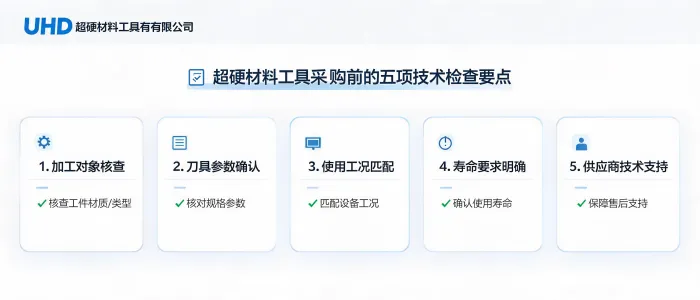
 UHD
ultrahard material tool procurement
technical checks
selection risk
operating condition matching
UHD
ultrahard material tool procurement
technical checks
selection risk
operating condition matching
 442
|
UHD Ultrahard Tools Co., Ltd
diamond tool purchasing
vacuum-brazed diamond tools
tool service life
machining efficiency
442
|
UHD Ultrahard Tools Co., Ltd
diamond tool purchasing
vacuum-brazed diamond tools
tool service life
machining efficiency
 221
|
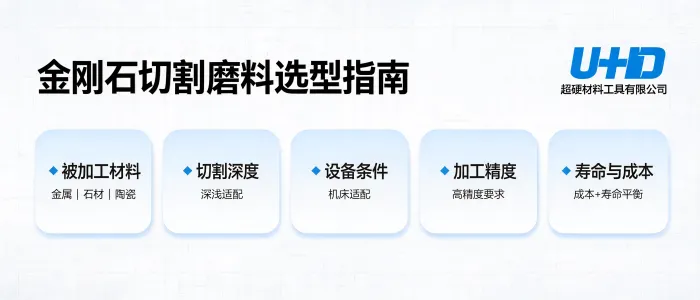
UHD Ultrahard Tools
diamond cutting abrasives selection
industrial cutting tools
tool compatibility
processing efficiency
308
|
UHD Ultrahard Tools
diamond tool selection
cutting tool selection
grinding tool selection
industrial processing solution
221
|
UHD Ultrahard Tools
diamond cutting abrasives selection
industrial cutting tools
tool compatibility
processing efficiency
308
|
UHD Ultrahard Tools
diamond tool selection
cutting tool selection
grinding tool selection
industrial processing solution
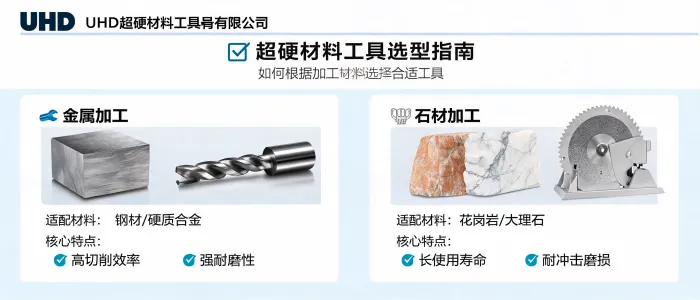 57
|
UHD Ultrahard Tools Co., Ltd
tool selection
metal processing
stone processing
wear resistance
57
|
UHD Ultrahard Tools Co., Ltd
tool selection
metal processing
stone processing
wear resistance