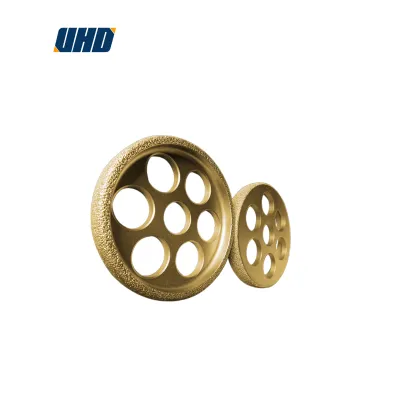
Common Buying Mistakes in Vacuum-Brazed Diamond Tool Selection
2026-08-11
UHD Ultrahard Tools Co., Ltd
Misconception Correction
UHD explains why price, diamond hardness, and theoretical tool life are not the only criteria when evaluating vacuum-brazed diamond cutting tools for industrial applications.
Selecting a vacuum-brazed diamond cutting tool for industrial use involves more than comparing unit prices or choosing the highest available diamond hardness. A tool that appears economical on paper may not deliver the best result if its structure, abrasive exposure, or working conditions do not match the material and machining process. UHD Ultrahard Tools Co., Ltd recommends evaluating the complete relationship between material compatibility, machining efficiency, operating stability, service life, and total tool cost.
Why the purchasing decision requires a broader view
Vacuum-brazed diamond tools are used in demanding cutting and grinding applications where the interaction between the abrasive layer, tool body, workpiece, and machine affects the final result. For this reason, a purchasing decision should not be based on one isolated parameter. The right assessment begins with the actual application and then considers how the tool is expected to perform in production.
Common evaluation mistakes in industrial tool purchasing
1. Choosing mainly by unit price
A lower purchase price does not automatically mean a lower processing cost. If a tool cuts slowly, requires frequent replacement, or creates unstable production conditions, the apparent saving may be offset by downtime, labor, setup changes, and reduced output.
2. Treating diamond hardness as the only quality indicator
Diamond hardness is relevant, but it is only one part of tool performance. Abrasive selection must also be considered alongside the workpiece, cutting conditions, tool design, abrasive exposure, and the required balance between cutting ability and wear resistance.
3. Relying on theoretical service life
A stated or expected service life may not reflect actual production conditions. Workpiece variation, machine settings, operator practice, cutting load, and the required finish can all influence real tool consumption. Service life should therefore be assessed together with productivity and process stability.
Key factors to review before selecting a tool
A structured review helps industrial buyers compare vacuum-brazed diamond cutting tools on a consistent basis. The following factors provide a practical starting point:
| Evaluation factor |
Questions for the buyer |
| Material being processed |
What material is being cut or ground? How consistent are its hardness, structure, thickness, and surface condition? |
| Tool structure |
Is the tool geometry appropriate for the required cut, access, clearance, and machine setup? |
| Abrasive exposure |
Does the abrasive layer provide the required cutting access without creating unnecessary instability or premature wear? |
| Machining efficiency |
Will the tool support the required cutting speed, feed rate, output, and process rhythm? |
| Operating stability |
Can the tool operate consistently under the available machine conditions and production requirements? |
| Total tool cost |
What is the combined impact of purchase price, tool consumption, downtime, labor, replacement frequency, and output? |
A practical selection process
- Define the application: identify the workpiece, cutting or grinding operation, required dimensions, surface expectations, and production conditions.
- Describe the machine environment: review the available equipment, operating parameters, fixture conditions, cooling approach where applicable, and operator requirements.
- Match the tool structure to the task: consider tool geometry, working access, abrasive exposure, and the balance between cutting performance and wear resistance.
- Compare process results, not only specifications: evaluate cutting response, stability, finish requirements, replacement frequency, and overall productivity.
- Confirm the commercial fit: ensure that the selected solution can be supplied consistently and supported with clear technical communication for the intended market.
When a technical discussion adds value
Buyers may need additional technical discussion when the workpiece is difficult to process, the application involves variable materials, or the current tool produces inconsistent results. In these situations, sharing application details is more useful than requesting a comparison based only on price or diamond hardness.
- Material type and relevant workpiece characteristics
- Cutting or grinding method and machine configuration
- Required production efficiency and acceptable finish
- Observed issues such as rapid wear, low cutting ability, vibration, or unstable operation
- Priorities among tool life, machining efficiency, process stability, and total cost
The most suitable vacuum-brazed diamond tool is not necessarily the cheapest or the hardest. It is the tool whose structure and abrasive characteristics are appropriate for the material, machine, operating conditions, and total production objective.
With experience in the development and supply of superhard material tools, UHD Ultrahard Tools Co., Ltd supports industrial buyers in evaluating vacuum-brazed diamond cutting and grinding solutions from an application-oriented perspective. The goal is to connect tool selection with practical machining requirements while maintaining a clear focus on quality, suitability, and reliable B2B cooperation.



.png?x-oss-process=image/resize,m_fill,h_300,w_300/format,webp)

.png?x-oss-process=image/resize,m_fill,h_300,w_300/format,webp)





.png?x-oss-process=image/resize,m_fill,h_400,w_400/format,webp)