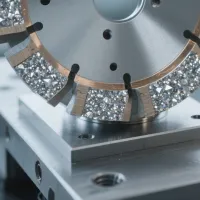
Vacuum brazing technology has revolutionized the manufacturing of high-performance diamond cutting blades by enabling stronger diamond grain bonding, enhancing blade durability, and significantly improving cutting precision. Unlike conventional brazing methods, vacuum brazing occurs in a contaminant-free environment, reducing impurities and preserving the integrity of the cutting tool’s surface. This advanced process delivers superior performance particularly in demanding metal cutting applications involving cast iron, steel, and other hard alloys.
At its core, vacuum brazing involves heating the diamond cutting segments within a controlled vacuum chamber, typically under pressures below 10-3 Torr. This low-pressure environment prevents oxidation and unwanted chemical reactions that often degrade bonding agents in traditional atmospheric brazing. As a result, the braze filler metal uniformly wets and firmly adheres to the diamond grains, forming microstructures that maximize mechanical interlocking and metallurgical bonding.
Research indicates that vacuum brazing can improve bond strength by 20%-30% compared to conventional methods, directly translating to extended blade lifespan and consistent cutting performance. Further, the absence of residual gases reduces void formation within the bond interface, ensuring predictable mechanical properties throughout the tool’s service life.

The reliable bonding facilitated by vacuum brazing significantly increases resistance to diamond grain loss during high-stress cutting operations. This translates into enhanced durability for diamond segments, allowing blades to maintain sharpness and cutting efficiency over longer operational cycles.
Moreover, the uniform distribution and secure fixation of diamond grains contribute to precise geometric stability of the cutting edge. This stability enhances dimensional accuracy and surface finish quality in metal cutting, which is critical in automated manufacturing environments where tolerances often fall within micrometer ranges.
Data from industrial trials demonstrate that vacuum-brazed diamond blades can reduce cutting deviations by up to 15% compared with standard brazed equivalents, notably improving yield and reducing post-processing requirements.
.png)
Vacuum brazing’s hallmark is its capacity to drastically lower oxygen and nitrogen levels during the joining process. This elemental control prevents oxidation of the metal matrix and the diamond surface, which otherwise deteriorate blade efficiency and longevity.
The minimized contamination directly correlates with fewer micro-cracks and surface defects, reducing susceptibility to thermal and mechanical fatigue. Furthermore, maintaining surface integrity during brazing ensures that the diamond cutting layer retains optimum hardness and toughness properties essential for cutting demanding materials.
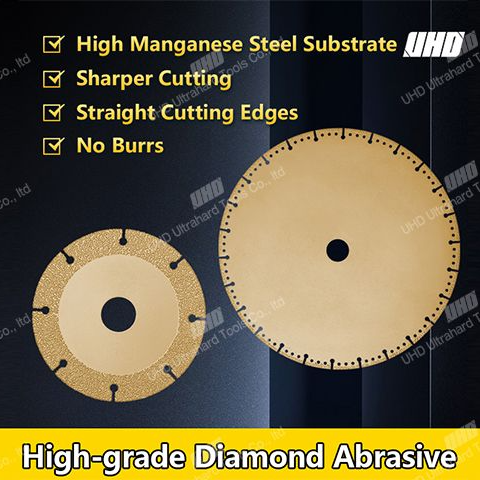
The integration of vacuum-brazed diamond blades in automated cutting systems offers tangible operational benefits. Increased tool life and precision lead to extended intervals between blade replacements and recalibrations, effectively minimizing equipment downtime.
In turn, manufacturers report up to a 25% improvement in production throughput and a significant drop in scrap rates when implementing these diamond blades, thereby elevating overall operational efficiency.
These factors, combined with reduced maintenance demands, underpin the compelling value proposition vacuum brazing adds to modern metal cutting workflows, especially for high-volume, precision-critical industries such as aerospace, automotive, and heavy machinery manufacturing.
Discover how our vacuum brazing technology can elevate your metal cutting processes with enhanced precision and unmatched durability. Contact our expert sales team or request detailed product information to optimize your production line performance.


 451
|
451
|
 Diamond saw blade detection
High - temperature saw blade state monitoring
Cutting tool performance evaluation
Portable microscope application
Infrared temperature measurement for cutting tools
446
|
diamond saw blade chipping
gray cast iron cutting
thermal stress control
cutting parameter optimization
foundry machining
275
|
Diamond saw blade chipping
Gray cast iron cutting process optimization
Saw blade thermal stress control
Cutting parameter setting guide
Foundry cutting solutions
333
|
Diamond saw blade detection
Extreme environment cutting
Cutting tool condition management
Portable detection methods
Saw blade performance evaluation
99
|
diamond saw blade chipping
gray cast iron cutting optimization
saw blade thermal stress
cutting parameter adjustment
diamond grain size selection
Diamond saw blade detection
High - temperature saw blade state monitoring
Cutting tool performance evaluation
Portable microscope application
Infrared temperature measurement for cutting tools
446
|
diamond saw blade chipping
gray cast iron cutting
thermal stress control
cutting parameter optimization
foundry machining
275
|
Diamond saw blade chipping
Gray cast iron cutting process optimization
Saw blade thermal stress control
Cutting parameter setting guide
Foundry cutting solutions
333
|
Diamond saw blade detection
Extreme environment cutting
Cutting tool condition management
Portable detection methods
Saw blade performance evaluation
99
|
diamond saw blade chipping
gray cast iron cutting optimization
saw blade thermal stress
cutting parameter adjustment
diamond grain size selection






.png?x-oss-process=image/resize,m_fill,h_300,w_300/format,webp)